The Feelings Wheel — Free Printable PDF for Kids

Help children identify and name their emotions with this free feelings wheel printable PDF. Perfect for parents, educators, and therapists working with kids aged 4–16.

Skills this printable covers:

  • Identifying and naming emotions accurately.
  • Building emotional vocabulary for children aged 4–16.
  • Understanding the spectrum from simple to complex feelings.
  • Developing emotional self-awareness and literacy.
Skills this printable covers:

  • Identifying and naming emotions accurately.
  • Building emotional vocabulary for children aged 4–16.
  • Understanding the spectrum from simple to complex feelings.
  • Developing emotional self-awareness and literacy.

Get new social stories to your inbox

Be the first to know when we launch new social stories, free resources and new craft activities - right to your mailbox.

When children can name their feelings, they gain the power to understand and manage them. The feelings wheel helps kids move beyond 'good' or 'bad' to develop rich emotional vocabulary.

A simple tool that builds emotional intelligence

  • Children learn to identify subtle differences between emotions
  • They develop the language to express how they really feel
  • They gain emotional self-awareness that lasts a lifetime
Feelings WheelFeelings Wheel

Watch emotional literacy grow

As children use the feelings wheel regularly, they become more articulate about their inner world and better able to communicate their needs.

Emotional awareness is the foundation of emotional intelligence and healthy relationships.
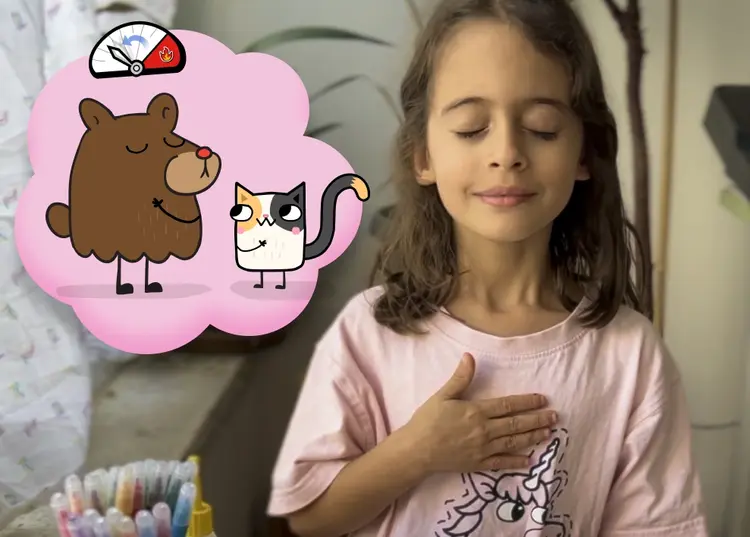
Child using feelings wheel to identify emotions

How to Use:

  1. Print or display on tablet
  2. Ask 'How are you feeling right now?'
  3. Let the child point to or circle their emotion
  4. Talk about what might have caused that feeling
Free Download
File size: 17.1 MBPages: 1 page

Feelings wheel and emotion wheel printable resources

Find feelings wheel pdf, emotion wheel printable, feelings chart printable, and emotion wheel for kids resources. Perfect for parents, teachers, therapists, and counselors teaching emotional literacy to children aged 4–16. Includes DBT emotion wheel, somatic feelings wheel, and therapy-focused tools.

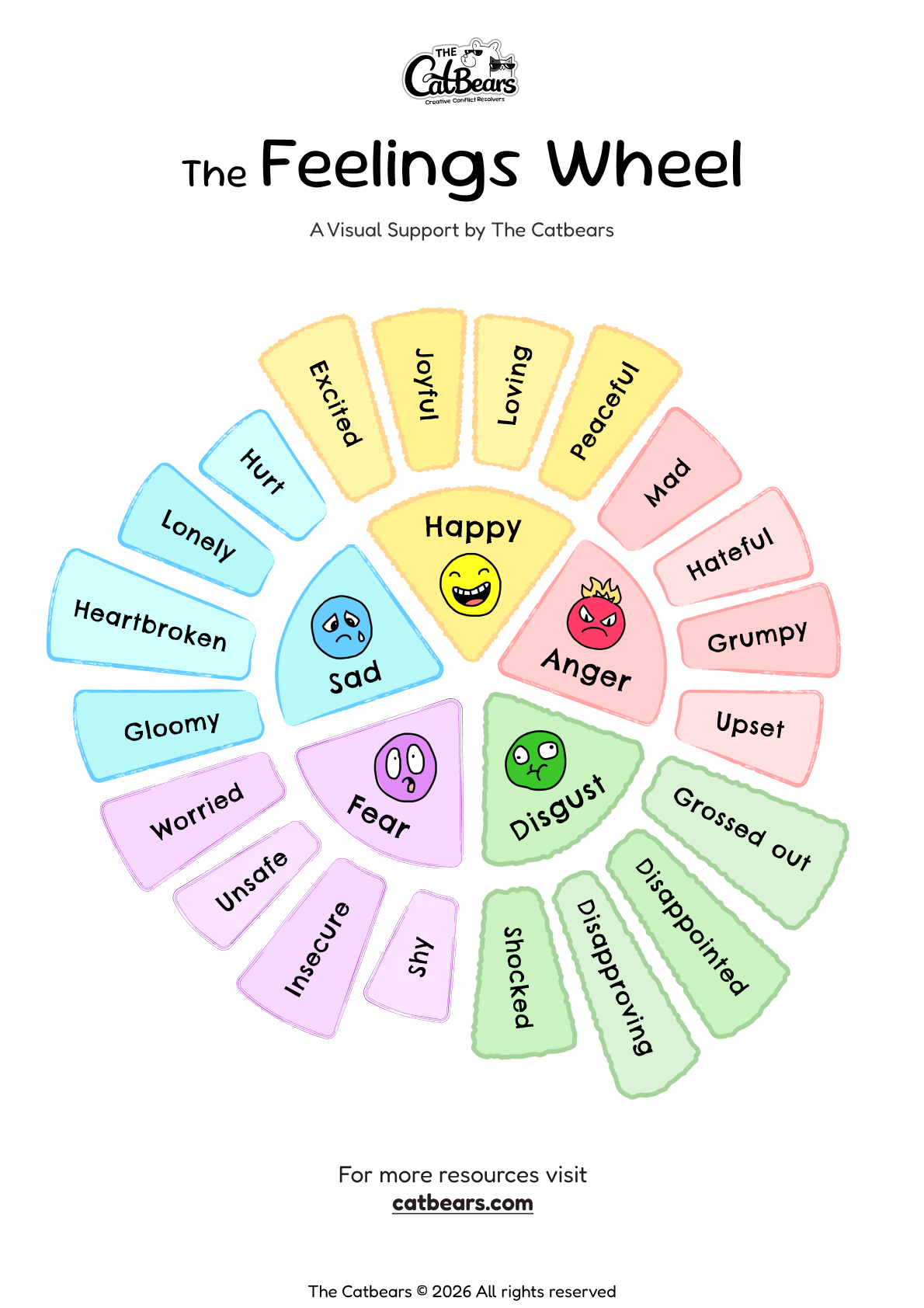
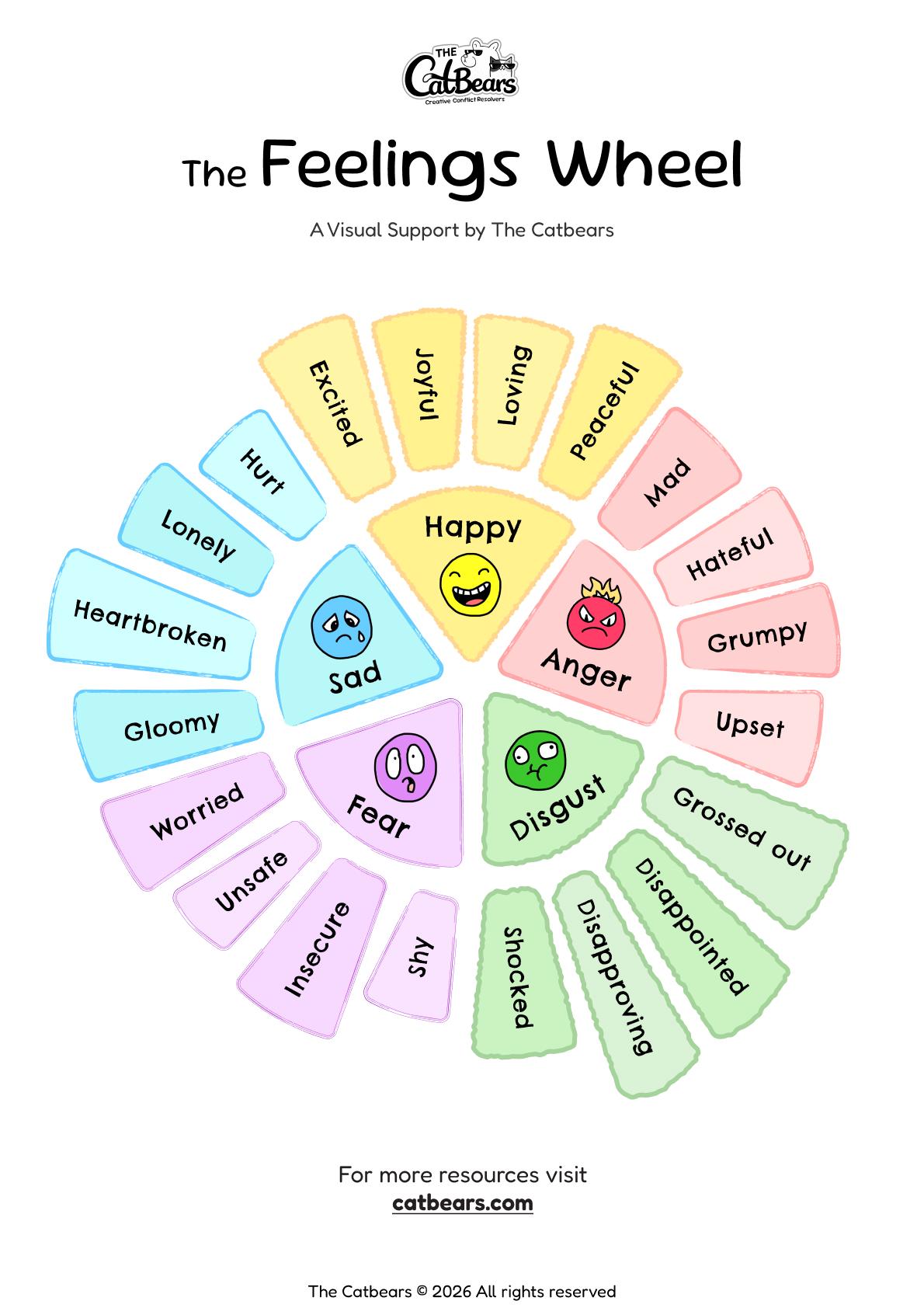
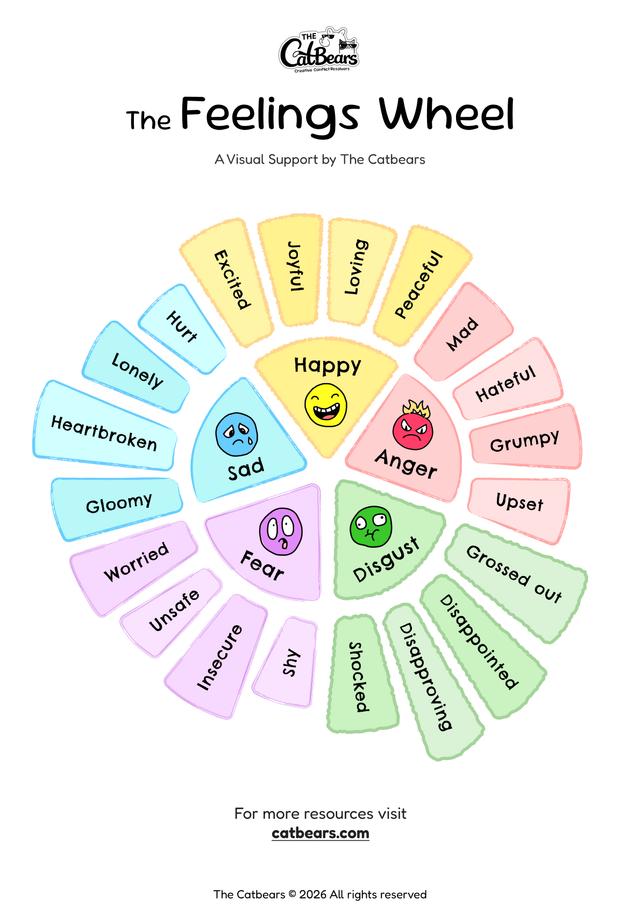
A feelings wheel (also called an emotion wheel) is a visual tool that helps children identify and name their emotions. It typically displays emotions in layers — from basic feelings like 'happy' or 'sad' in the center to more nuanced emotions like 'grateful,' 'lonely,' or 'overwhelmed' in the outer rings. It's a powerful tool for developing emotional vocabulary and self-awareness.
The Catbears Feelings Wheel is designed for children aged 4 to 16. Young children can start with the simpler, core emotions, while older children and teens can explore the more complex feelings in the outer layers. The visual format makes it accessible across developmental stages.
This printable is ideal for parents, teachers, school counselors, therapists, occupational therapists, and anyone working with children on emotional development. It works beautifully at home during check-ins, in the classroom for social-emotional learning, and in therapy or counseling sessions.
Yes! The feelings wheel is a visual, non-verbal tool that works exceptionally well for children who are visual learners or who struggle with verbal expression. Many therapists use emotion wheels specifically with neurodivergent children because it provides a concrete, tangible way to explore abstract emotions.
Yes, completely free. Download, print, and use it as many times as you need — at home, in your classroom, or in your practice. No sign-up required.
Absolutely! You're welcome to print and use the feelings wheel with as many children as you like. We only ask that you don't resell or redistribute the PDF itself.
The feelings wheel works best during calm moments — not during a meltdown. Use it for daily emotional check-ins, after school, during therapy sessions, or when a child seems to be struggling but can't quite find the words. You can also introduce it proactively to build emotional vocabulary over time.
Start by asking, "How are you feeling right now?" Let them look at the wheel and point to the emotion that feels closest. If they're not sure, you can help by asking questions like, "Are you feeling more happy or sad?" or "Does this feel like a big feeling or a small feeling?" Over time, they'll develop the skill to identify emotions independently.
Yes! Laminating the feelings wheel is a great idea — especially if you plan to use dry-erase markers so children can circle their emotions and wipe it clean for next time. This makes it reusable and perfect for daily check-ins.
A customizable blank feelings wheel template is coming soon. Sign up for our mailing list to be notified when it's available.
The Catbears is an EdTech initiative founded by a multidisciplinary team of therapists, educators, and creative designers. All of our content is developed in close collaboration with speech therapists, occupational therapists, and classroom teachers to ensure it's both evidence-based and child-friendly.
Yes. Emotion wheels are widely used in therapeutic settings, including CBT, DBT, emotion-focused therapy, and mindfulness practices. The ability to identify and name emotions — a skill called emotional granularity — is linked to better emotional regulation, mental health, and interpersonal relationships. The Catbears Feelings Wheel brings this evidence-based tool to children in a warm, accessible format.
Absolutely. The feelings wheel is a staple tool in many therapeutic approaches, including Dialectical Behavior Therapy (DBT), Cognitive Behavioral Therapy (CBT), and emotion coaching. Therapists often use emotion wheels to help clients develop emotional awareness, practice distress tolerance, and improve communication.