When children don't respect personal space, it's not because they don't care. It's because they haven't learned to read the signs.

Why this is hard

"Not so close" is not a thing a child can picture

If personal space has become a daily conversation in your house or classroom, you already know the shape of it. The reminder that does not stick. The look from another parent at the playground. The tiredness of explaining the same thing again, in a slightly different way, hoping this is the time it lands.

For a lot of children, and especially autistic children, the usual advice does not give them anything to hold. "Give people space" describes a rule without describing what to do. Space is not a fixed distance either. It changes with the person, the room, and the moment, which makes it feel less like a rule and more like a test nobody explained.

  • The child is not being rough on purpose. They are moving, and someone was close.
  • Corrections arrive after the fact, so the child hears what went wrong but not what to do instead.
  • "Personal space" is invisible, and abstract words are the hardest kind to learn from.
  • The signals that tell you to step back are quick, quiet and easy to miss.

So the child ends up corrected often and understood rarely. That is the gap this story is built to close.
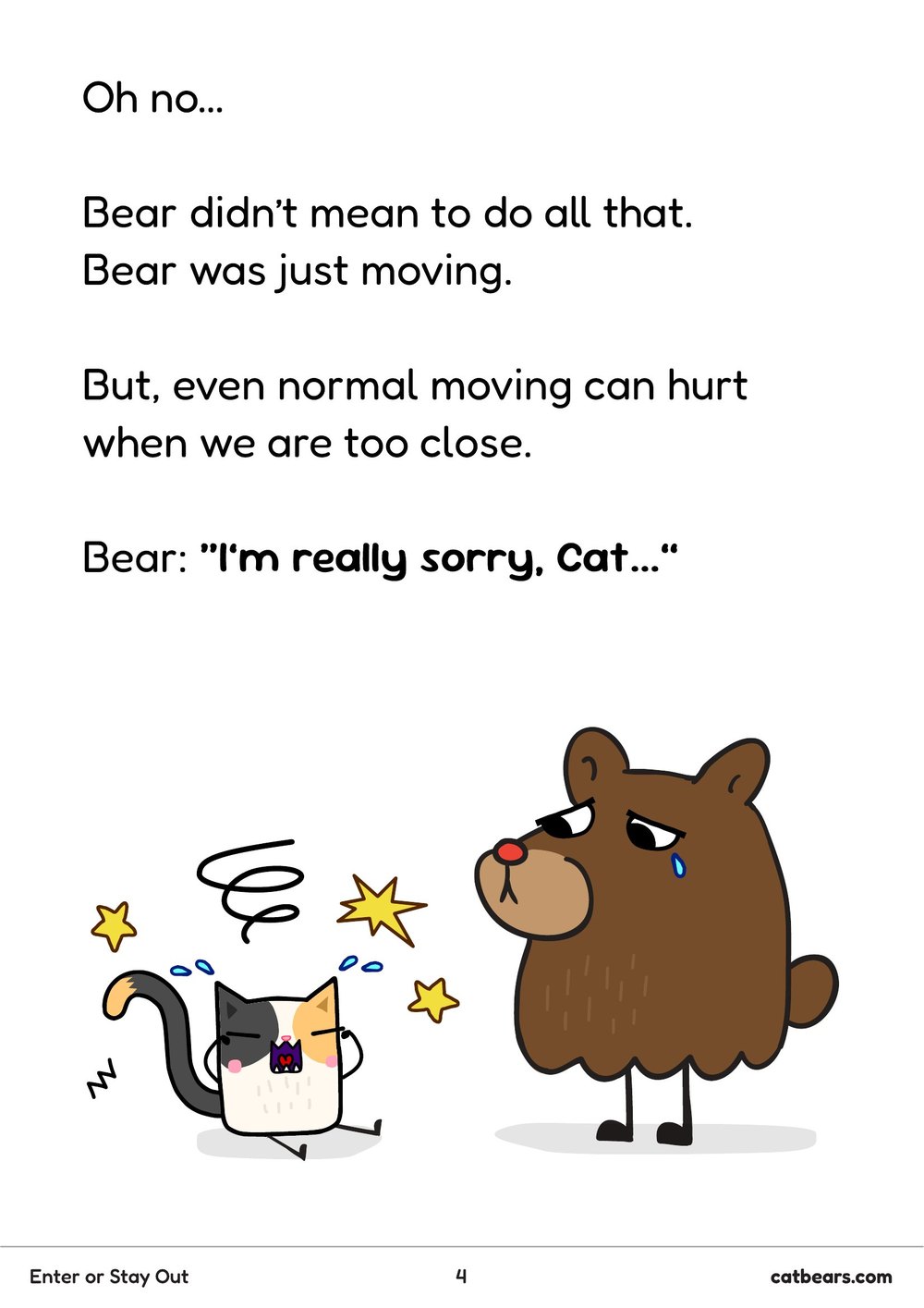
Story page where Bear apologises after knocking Cat over without meaning to
Read it before you buy it

What happens inside the story

Nineteen pages, three short chapters, and one idea a child can actually act on: personal space is not a wall, it is something you can read.

1

What personal space is

Bear sneezes. Bear stretches. Bear bends over to pick up a ball. Bear dances. Every one of those is ordinary, and every one of them ends with Cat getting knocked about, because Cat was standing right there.

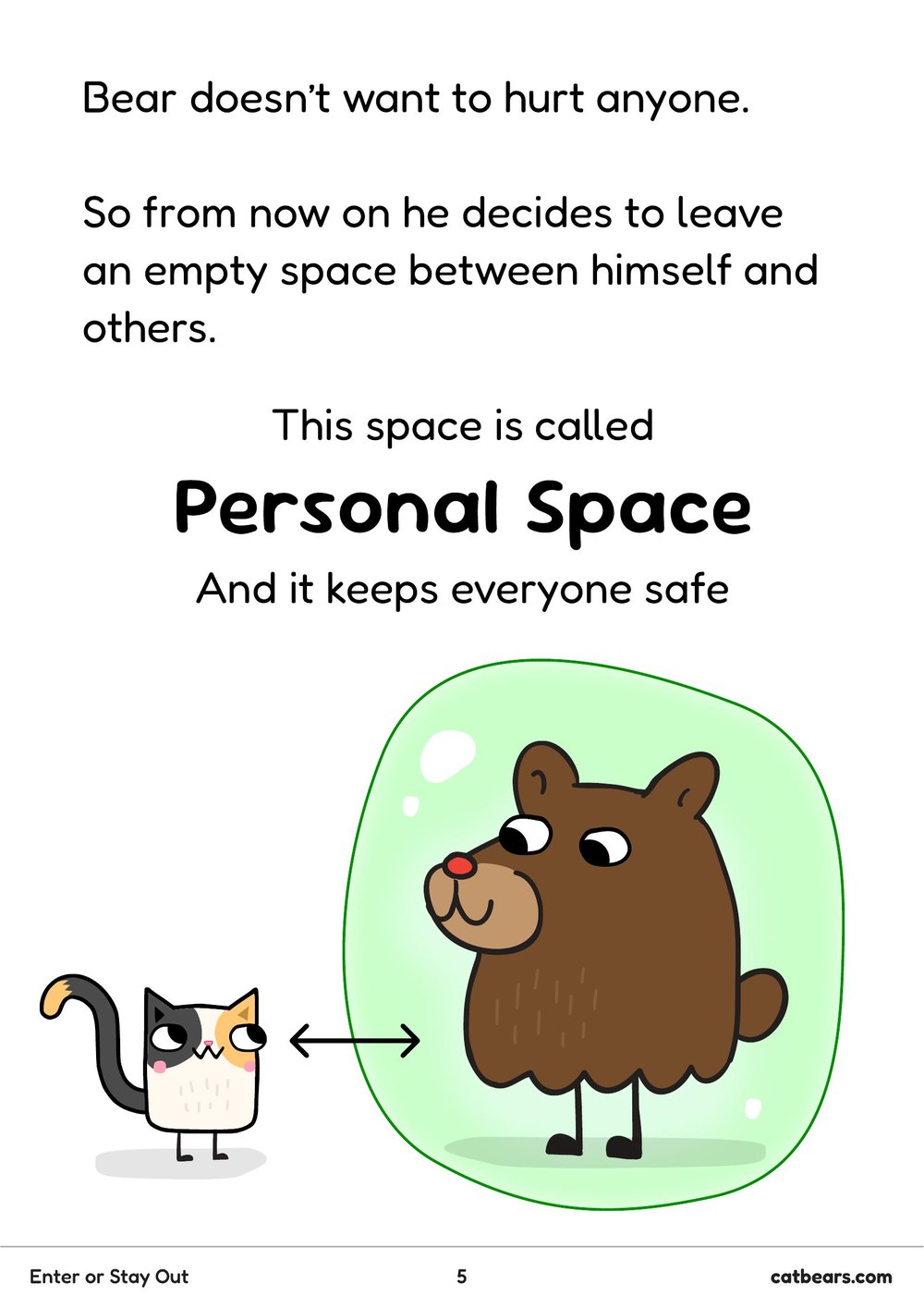
The story is careful about this: Bear did not mean to do any of it. Bear was just moving. Normal moving can hurt when we are too close. So Bear decides to leave an empty space around himself, and the story gives that space its name.

Story page naming the empty space around Bear as personal space
2

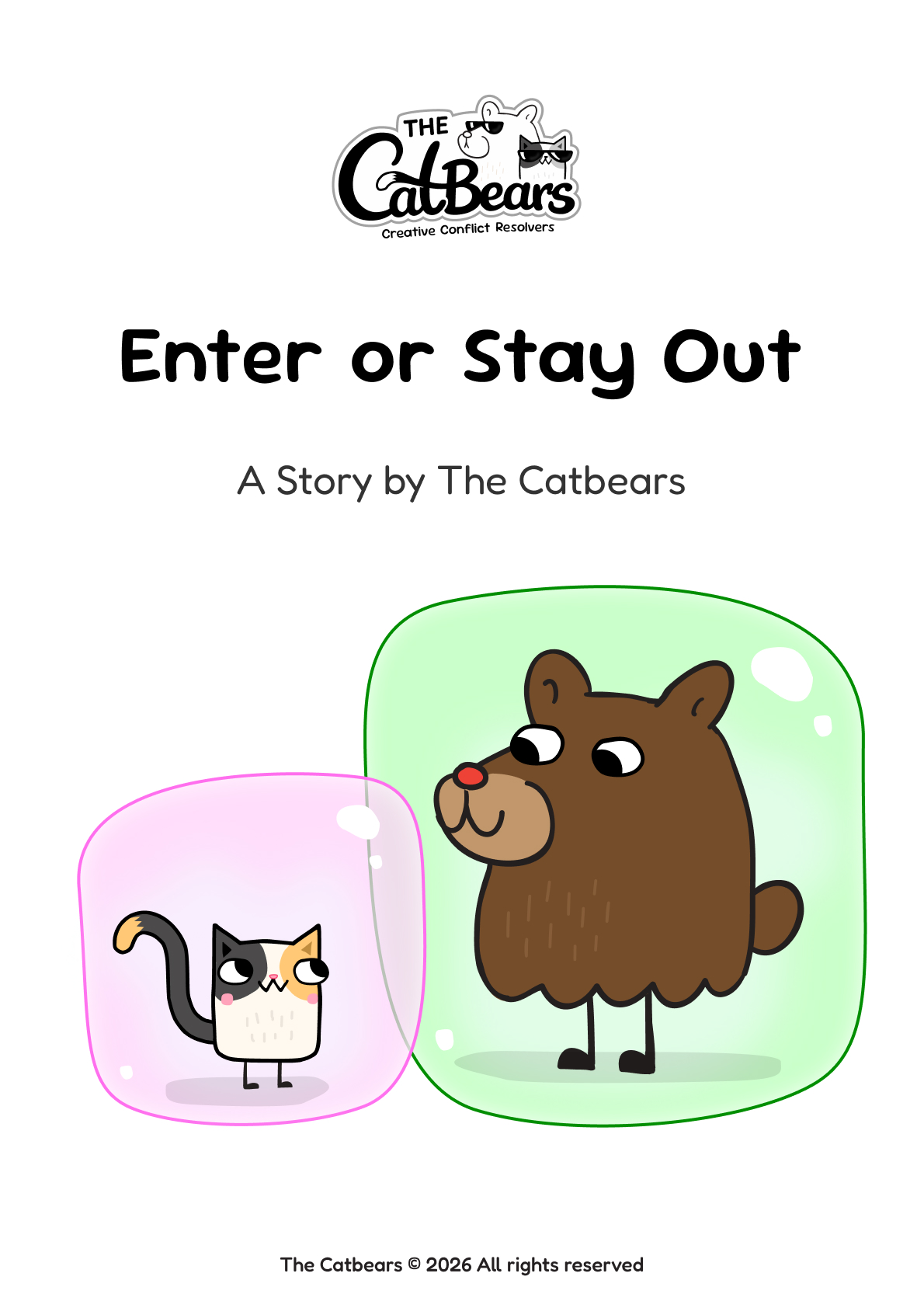
Enter, or stay out

Here is where the story parts ways with most personal space material. It does not tell children to keep away from people. It tells them the space opens and closes, and that other people are constantly saying which.

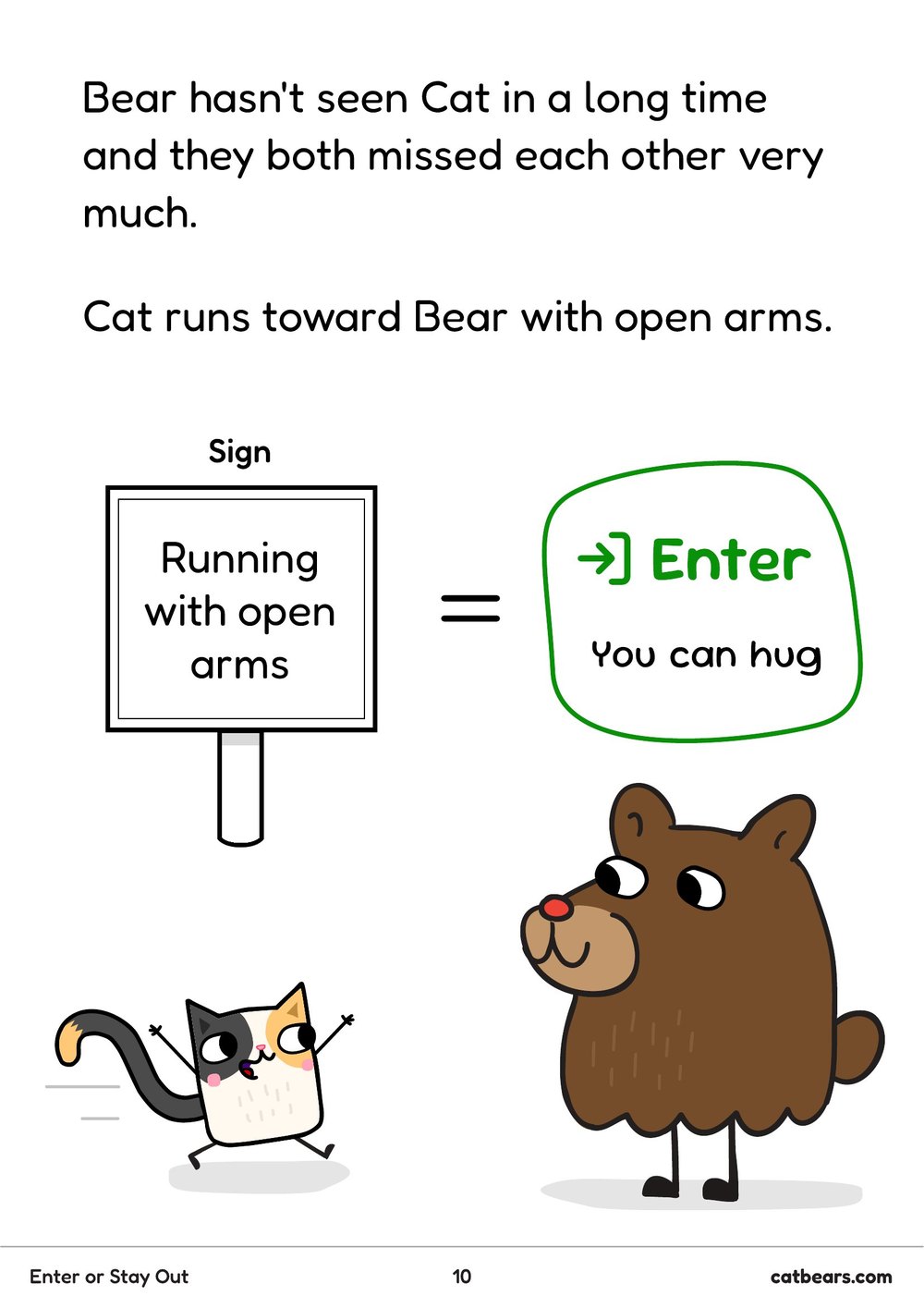
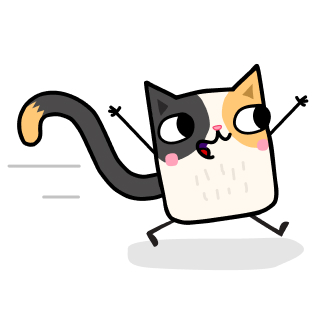
Cat runs over with open arms, and the story shows the child what that means: enter, you can hug. Cat takes a step back while Bear is talking: stay out, give some space. Everyone is playing tag: enter, a quick touch is okay. Same two children, three different answers, and a way to tell them apart.

Story page showing that running with open arms means enter, you can hug
3

Ask when you are not sure

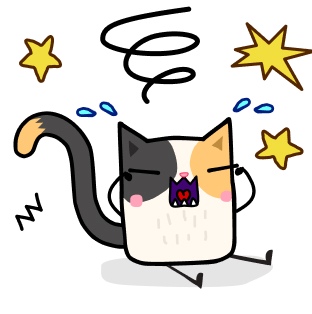
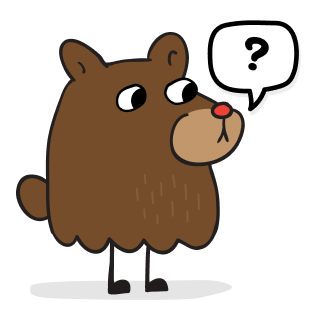
Then the story does the thing children need most. It admits the signs are sometimes unreadable. Cat is upset, and Bear looks at the sign and simply does not understand it.

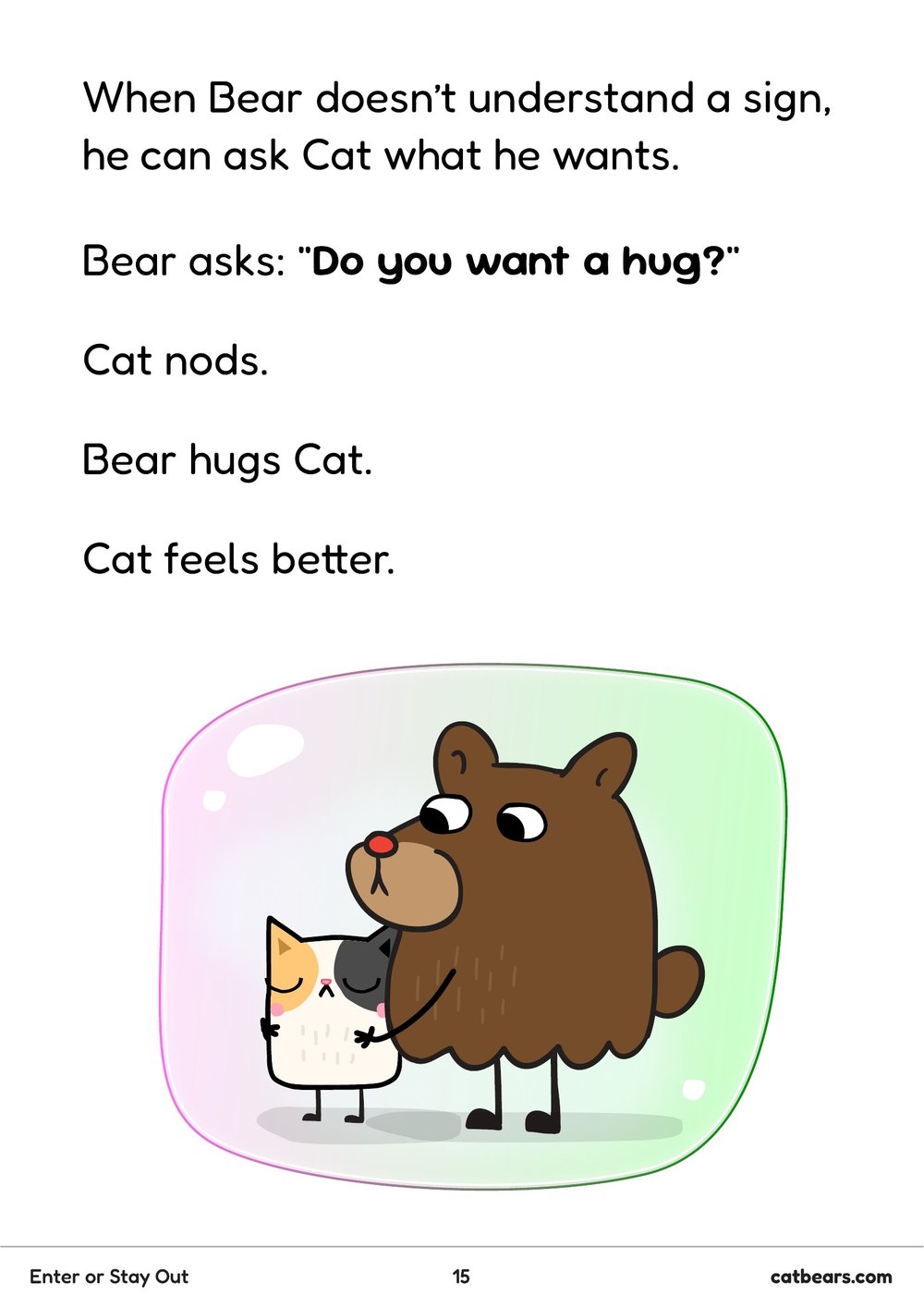
Bear does not guess and he does not freeze. He asks: "Do you want a hug?" Cat nods. Bear hugs Cat, and Cat feels better. Not knowing turns out to be a normal part of it, with something to do about it.

Story page where Bear asks Cat if Cat wants a hug, and Cat nods

Bear ends the story knowing three things: what personal space is, how to look for signs, and that asking is always allowed.

This isn't just a story. It's a practice.

  • Children learn what personal space is
  • They practice looking for body language signs
  • They learn to ask when they're not sure
Why Personal Space Matters Why Personal Space Matters
Open arms means enter Open arms means enter
Stepping back means stay out Stepping back means stay out
Not sure? Just ask Not sure? Just ask
After the last page

Two words you can both use, all week

The reason to read this one more than once is the shared language. Once a child knows "enter" and "stay out," you stop correcting and start asking. "Does this mean enter, or stay out?" is a question a child can answer, and answering it is the whole skill.

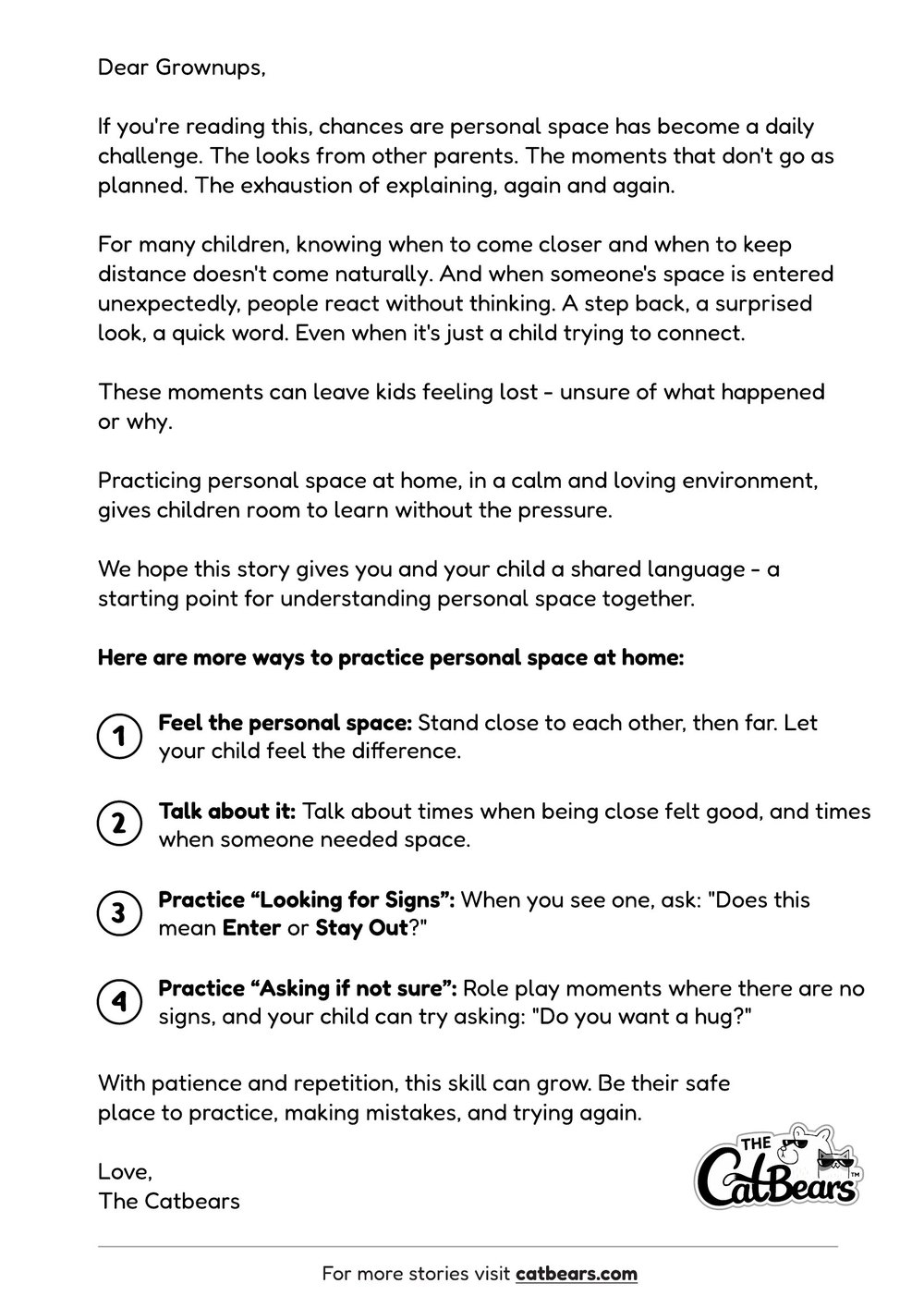
The story comes with a letter for grownups and four ways to practise, so the learning happens in calm moments rather than in the difficult ones.

  1. Feel the space Stand close to each other, then far apart. Let your child feel the difference in their own body.
  2. Talk about it Remember times when being close felt lovely, and times when someone needed room.
  3. Look for signs Spot one together out in the world and ask: does this mean enter, or stay out?
  4. Practise asking Role play the moments with no clear sign, so "do you want a hug?" is already familiar when it counts.
The letter for grownups included with the story, with four ways to practise personal space at home
The grownups letter, included with the PDF

Over time you'll see progress

Children learn to notice the signs and make better choices about when to be close and when to give space.

A skill that helps children connect with others safely.

Bear and Cat characters demonstrating personal space boundaries for kids

How to Use:

  1. Print or open on tablet
  2. Read together regularly
  3. Practice looking for signs in daily life

$4.99one-time payment

Instant download
File size: 4.9 MB Pages: 19 pages

Personal Space Resources for Kids

This personal space social story PDF teaches children what personal space means and how to read body language signs. Unlike other resources that simply say 'keep your distance,' this visual support shows children that personal space is flexible - sometimes we enter, sometimes we stay out. It's about learning to look for signs like open arms, stepping back, or crossed arms. Perfect as a personal space worksheet alternative, this printable works for autism, ADHD, and any child learning social boundaries.

What parents, educators and therapists say

The people below know The Catbears from years of using our stories with children, at home, in classrooms and in practice.

There is no better time than today to equip our children with life skills and tools for social challenges. The Catbears provides this solution.
Michal Daliot "Super Nanny." Senior educator and family consultant. CEO of the Michal Daliot Center, providing training and consulting for parents and family counselors.
The Catbears activities significantly strengthen children's ability to resolve everyday conflicts.
Yael Biber Aviad Trailblazing educator. Founded and led innovative schools introducing progressive methods like democratic education and project-based learning. Currently promotes alternative education and social equality in schools.
Children discover their ability to handle everyday conflicts in wonderfully creative and original ways.
Dr. Gish Amit Author, education researcher, and school principal. His work combines educational research with practical application, emphasizing emotional-social connections between teachers and students.
Stories and games that offer original, captivating approaches to resolving conflict and building inclusive, unifying dialogue.
Yehonathan Doron Leading educator and lecturer. Manages youth educational frameworks. Runs a parent-teen clinic. TEDx speaker and TEDx mentor.
A model of educational innovation.
Rotem Ganot Head of Personalized Learning, R&D Division, Ministry of Education.
My son used to get right up in people's faces. Now he actually stops and looks for the signs. The 'enter or stay out' words stuck with him.
Talia Parent

A personal space social story is a visual teaching tool that helps children understand boundaries. It teaches them when it's okay to be close to someone and when they should keep distance, using simple language and pictures they can easily understand.

A personal space bubble is the invisible area around a person's body where they feel comfortable. This social story teaches children that everyone's bubble is different - some people like close contact, others need more space. The key is learning to read the signs that tell you whether someone's bubble is open or closed.

This personal space story is designed for children aged 3 to 8. It uses simple language and engaging visuals that work for toddlers, preschoolers, and early elementary students who are learning social boundaries.

This tool is designed for parents, teachers, and therapists working with children who struggle with personal space. It works well for visual learners and any child developing social awareness skills.

Yes. Many children with autism or ADHD find personal space confusing. This story breaks it down into clear, visual steps - teaching them to look for signs that tell them when to enter someone's space and when to stay out.

After reading this story, practice with games: Have your child approach you and stop when they see a 'stay out' sign (crossed arms, stepping back). Then show 'enter' signs (open arms, smiling, leaning in). You can also practice with stuffed animals or while watching TV - pause and ask 'enter or stay out?' when characters interact.

It is a $4.99 one-time purchase. You get the full 19-page personal space social story as a PDF to read on a screen or print, at home, in the classroom, or in a clinic. Pay once and download it right away.

Most personal space stories just say 'give people space.' This story teaches children that personal space isn't a rule to always keep distance - it's about knowing when to enter and when to stay out. It gives them practical signs to look for and teaches them to ask when they're unsure.

Read it when your child is calm and relaxed. Go through the signs together and practice identifying them. Then, in daily life, point out signs when you see them and ask: 'Does this mean enter or stay out?'

We recommend reading it daily for the first week, then as needed. The real learning happens when you practice spotting signs in everyday moments - at home, at the playground, with family and friends.

That's completely normal. Personal space is learned through practice and repetition. Keep pointing out signs gently, without pressure. Your home is their safe place to make mistakes and try again.

Social stories are a proven method for teaching social skills. This story gives children a clear framework - 'enter' or 'stay out' - and teaches them to look for signs. With consistent practice, children learn to read social cues more confidently.

People also liked