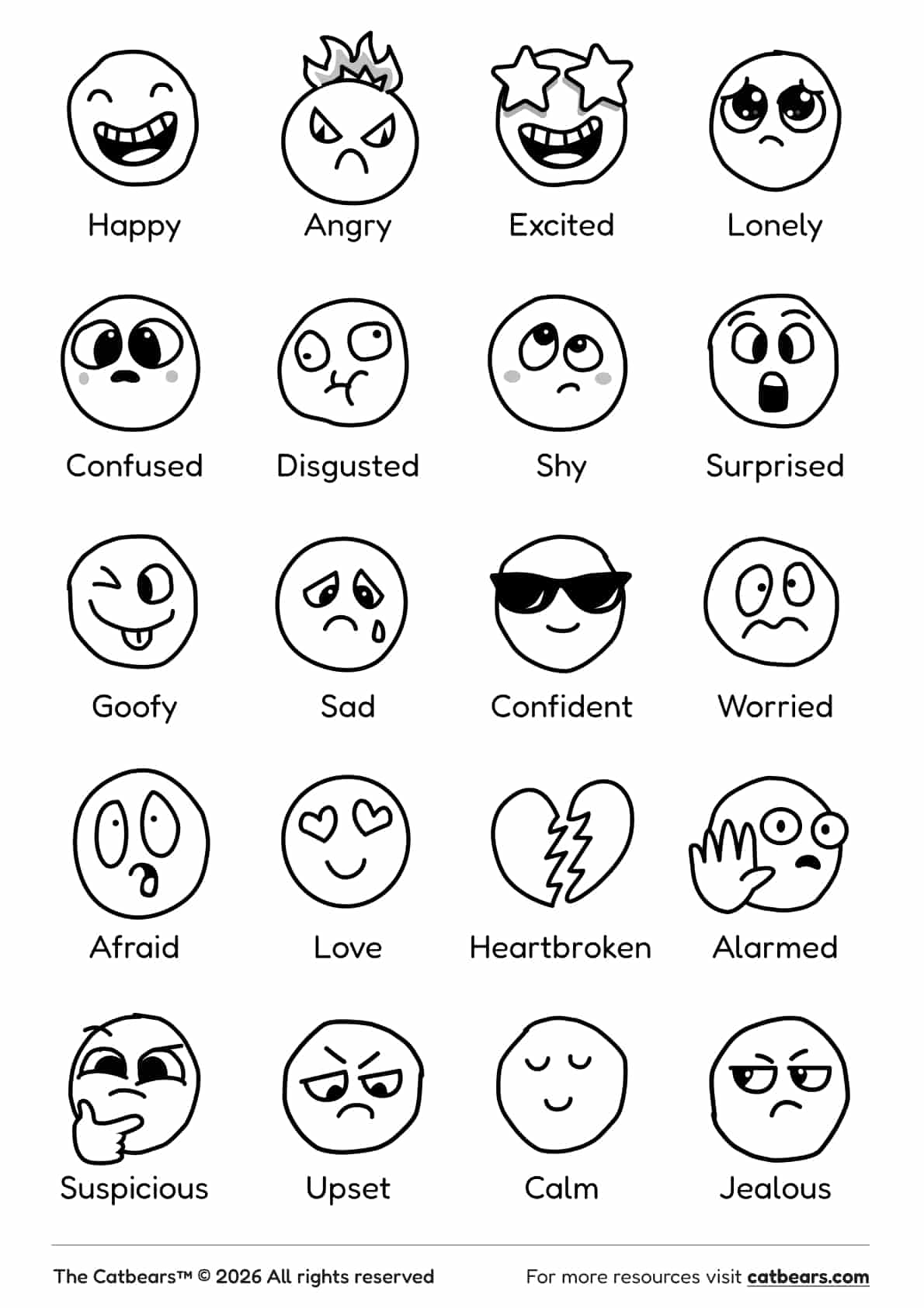
Coloring slows a child down. While their hands are busy, the pressure to explain a feeling goes away, and the words come more easily. A page of feeling faces gives kids a simple menu to point to and name.
A quiet way to grow feeling words
- Children match each face to the feeling it shows
- They meet feelings past happy and sad, like lonely, shy, and jealous
- They practice naming emotions while calm, not mid-meltdown
 Feelings Coloring Page
 Over time you'll see progress
As children color and name the faces, they start to use those same words for their own feelings. Naming a feeling is the first step to handling it.
Putting feelings into words is one of the most useful skills a child can build.
How to Use:
- Print the page or open it on a tablet
- Color one face at a time and say the feeling out loud
- Ask 'When do you feel this way?'
- Keep the finished page nearby to point to later
Feelings and emotions coloring page resources
A free feelings coloring page and emotions coloring sheet for kids. Print the emotion coloring pages for home, the classroom, or therapy, and use them to build emotional vocabulary while children color.
Stories and games that offer original, captivating approaches to resolving conflict and building inclusive, unifying dialogue.

One printable page with 20 feeling faces to color: happy, angry, excited, lonely, confused, disgusted, shy, surprised, goofy, sad, confident, worried, afraid, love, heartbroken, alarmed, suspicious, upset, calm, and jealous. Each face is labeled with its feeling word.
It works best for children aged 3 to 10. Toddlers and preschoolers can color the faces and name the simple feelings, while older kids can talk about the trickier ones like jealous, suspicious, or heartbroken.
A chart is finished and you point to it. This is a coloring page, so children slow down and spend time with each feeling as they color it. That hands-on time makes the feeling words stick.
Yes. As part of The Catbears mission, this coloring page is a 100% free resource for home, classroom, or therapy use. Print it as many times as you like. We only ask that you don't resell the PDF itself.
Yes. Feelings are abstract, and a simple face makes each one concrete. For visual learners, coloring a face and naming it gives a calm, low-pressure way to build emotional vocabulary.
Color together during a calm moment. Take one face at a time, name the feeling, and ask when they last felt that way. Later, when a big feeling shows up, you can point back to the face they colored.
Absolutely. Print a copy for each child for a social-emotional learning lesson, a morning check-in, or a counseling session. You are welcome to use it with as many children as you like.
Yes. The faces sort naturally into the Zones. Calm and happy sit in the green zone, worried, shy, and lonely in the blue, and angry, upset, or alarmed in the red. Kids can color each face and say which zone it belongs to.
They are close. Each feeling is a simple round face, much like the emoji kids already know, so a happy or sad face reads at a glance. That makes the emotions easy to recognize before a child can spell the word.
Yes. Use it as a color-your-feelings activity or a daily mood check-in. When a big emotion shows up, a child can point to the face that matches, which gives them a way to share how they feel without needing the exact words.