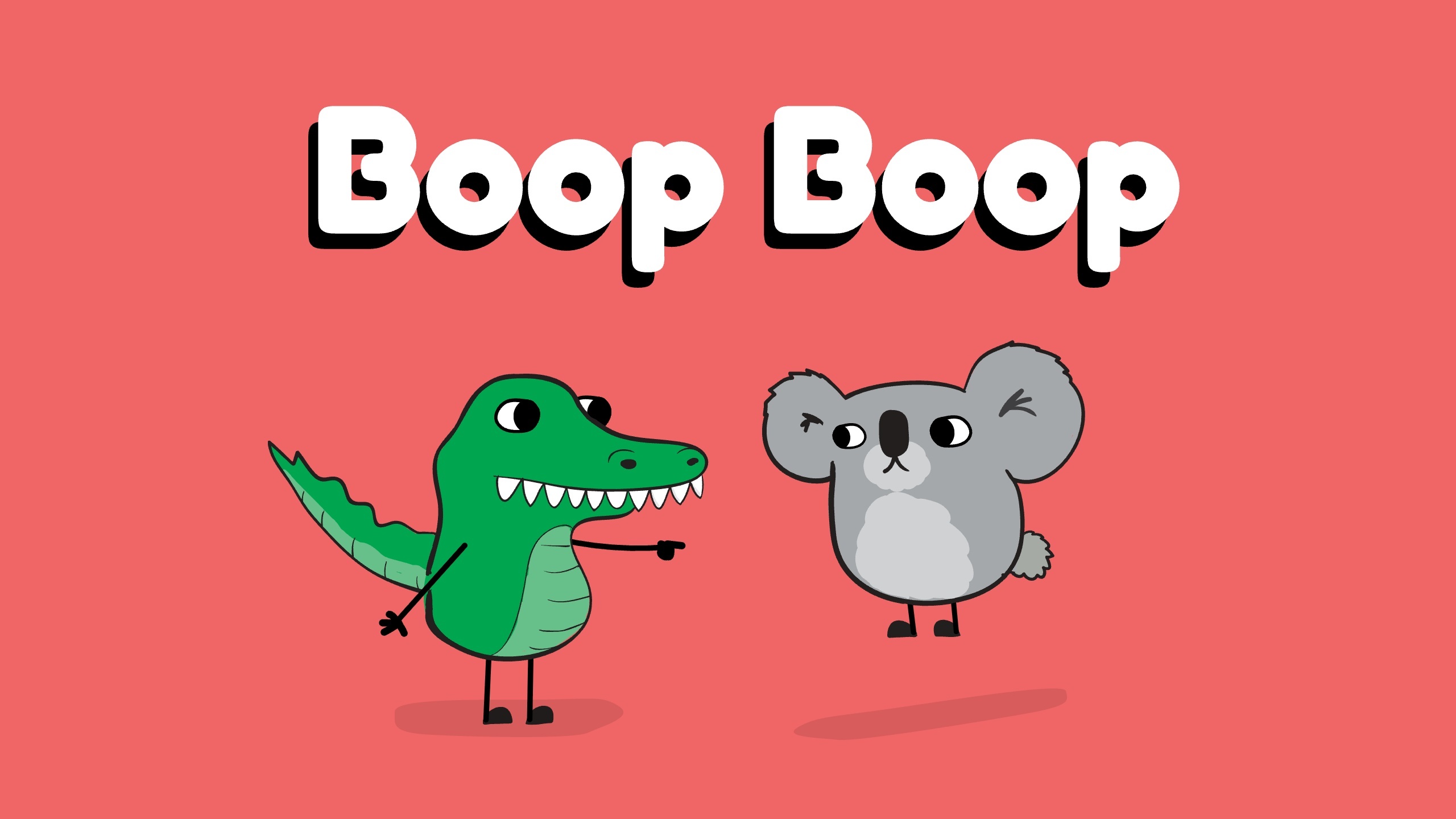
Try Boop Boop, our free SEL game where kids practice setting a boundary with a friend who will not stop.
Run SEL sessions in enough classrooms and living rooms and you start seeing the same moment over and over, until you cannot unsee it. Teachers describe it. Parents describe it. Ask a group of eight year olds and half the hands go up.
One kid is poking another. Not hard, not cruel. He is laughing, because to him this is the funniest game in the world, and every time his friend flinches it gets funnier. And the other kid is standing there with a small stiff smile on his face, laughing along, hating it.
He knows he does not like it. He could say so in one sentence. And he says nothing.
From the outside it looks simple. Just tell him to stop. But when you actually ask children afterward why they did not, it turns out they are not confused at all. They know precisely why they stayed quiet, and they can list the reasons faster than you can write them down. They are doing a risk calculation, and by their math, speaking up is the dangerous option.
Why setting a boundary feels so dangerous
Ask a seven year old what might happen if they tell their friend to stop, and the answers come fast, because they have already thought about it.
He will not like me anymore. He will not want to play with me. He will say I am too sensitive. He will think I am not fun. He will go play with someone else and then I will be the kid standing alone at recess. It is only a game, so if I make it a big deal, I am the one making it a big deal.
Sit with that list for a second, because it is not childish. It is a real accounting of real social costs, and children are not wrong that those costs exist. Friendship is the currency of childhood. When you are eight, a friend who stops wanting to play with you is not a minor inconvenience. It is your whole week.
So the child does the thing that feels safest. He laughs along. He acts like it is fine. He protects the moment, and he pays for it himself, quietly, and nobody in the world knows it happened.
The reframe that changes everything
Almost every child I have talked to about this carries the same quiet assumption: that a boundary is something you do against a friend. A small act of rejection you have to be brave or mean enough to commit.
It is the opposite.
A boundary is something you do for a friendship. It is one of the most caring things a person can offer another person, and it is worth saying out loud to a child in almost exactly those words.
Think about what a boundary is actually saying underneath. It is not "I am done with you." It is: I want to keep being your friend. Something in this is not working for me. And I am telling you, instead of just quietly pulling away, because I would rather fix it with you than lose you over it.
That is not the end of closeness. That is what closeness requires. Good friends listen to each other's needs. Good friends want to know when they have stepped on something, because no decent person wants to be the reason their friend is miserable. Telling a friend what you need is a form of trust. You are saying: I think you are the kind of person who would want to know.
The child who never says anything is not protecting the friendship. He is quietly deciding his friend cannot handle the truth, and building a small wall while smiling over the top of it.
Why kids get this backwards, and why we should name it early
Children do not invent the idea that having needs makes you difficult. They pick it up, from everywhere, in a hundred small transmissions.
They learn it from being told to be nice, and hearing it as be agreeable. They learn it from watching adults swallow their own irritation to keep a room pleasant. They learn it from the social currency of being chill, easygoing, up for anything, which starts early and only gets more powerful with age. Somewhere in there, "I do not like that" becomes a thing you think but do not say, because saying it makes you the problem.
This is why it matters so much to name it young, long before the stakes get high. A five year old learning that his needs are allowed to exist and are allowed to be spoken is a fifteen year old with a working sense of where he ends and other people begin. A twenty five year old who can say "that does not work for me" without a three day stomachache first.
We are not teaching a playground skill. We are teaching a person how to stay in relationships without disappearing inside them.
If a boundary is for the friendship, it has to sound like it
Here is where the reframe stops being philosophy and starts being practical, because it settles a question kids ask constantly: how do I say it?
Once a child understands that a boundary is an act of friendship, the how becomes obvious. It has to feel friendly. Warm, calm, plain. If it lands like an attack, the message does not arrive, no matter how right the child was.
This is why yelling usually fails, and it is worth being honest with kids about why rather than just telling them not to. When you shout "STOP IT, LEAVE ME ALONE" at a friend who genuinely thought he was playing, he does stop. But what he hears is not "my friend needs something from me." What he hears is "I am in trouble and I do not know why." He backs away hurt and confused, and the thing he learned is that you are scary sometimes, not that poking bothers you.
Threats do the same thing, faster and worse. "Do that again and I will hit you" works instantly and costs a fortune. Now your friend is a little afraid of you over a poking game, and he still has no idea what he did wrong. The behavior stopped. Nothing was understood.
Kids feel this asymmetry even when they cannot explain it, which is why so many of them freeze. They can sense that the loud options break something, and the quiet option is to say nothing at all, so they say nothing. What they are missing is the middle: the version that is firm and warm at the same time. That one is not obvious. It has to be shown, and practiced, and shown again.
The blind spot, and the words that get through it
One more thing children almost always get wrong about this moment, and it is the most forgivable mistake of all.
They assume the other person knows.
They assume it so completely that the friend's cheerful obliviousness reads as cruelty. He can see my face. He knows I hate this. He is doing it anyway, so he must not care. From inside that story, of course a child either gives up or explodes. Both are reasonable responses to someone hurting you on purpose.
But usually he does not know. Usually there is a genuine blind spot sitting right in the middle of the friendship, and the poking kid is having a great time on one side of it while his friend quietly suffers on the other. He is not ignoring a signal. He never received one, because a stiff smile is not a signal, and neither is one soft "um, can you stop" that got laughed over.
Which means the real skill here is not toughness. It is communication. Naming the invisible thing so the other person can finally see it.
The words that work tend to share three qualities, and these are worth teaching a child directly:
Kind. Aimed at the behavior, not at who your friend is. "I do not like being poked" instead of "you are so annoying." One of those can be fixed. The other is just an insult with a point.
Specific. Name the actual thing. Not "stop being like that," but "when you poke me over and over, I hate it." Vague complaints leave a friend guessing, and guessing usually ends with them guessing wrong.
Helpful. Say what you want to happen, not only what you want to end. "Please stop poking me" gives your friend somewhere to go. It hands them a way to be the good guy, which, given the chance, most kids take.
And then the sentence that does more work than any other, the one that turns a complaint back into a friendship: "If you are really my friend, you will stop when I ask. Friends listen to each other." It is not an accusation. It is an invitation. It reminds both of them what they are actually doing here.
The first try often does not land, and that is not failure
If there is one thing I wish every child knew going in, it is this.
The hard part of a boundary is almost never the first attempt. It is the second.
Because here is what really happens. The child gathers herself, says the brave clear thing, and her friend says "oh, okay" and then does it again four seconds later. Not out of malice. He is just deep in the game and it did not fully register.
And in that four second gap, a child learns the wrong lesson at speed: I tried, it did not work, so this does not work. That is the moment most kids give up and reach for the fake smile, and it is the moment they need us most, because the truth is almost the reverse. One try is how a boundary gets mentioned. Two tries is how it gets heard.
So tell them in advance. Tell them the second time is coming and it is normal, not a sign they did it wrong. "Jordy. I mean it. Stop. It is not funny." Same warmth, more weight.
And if it still does not land, there is one more move worth putting in a child's pocket, because it is the difference between a boundary and a threat. Name something you control. "Stop, or I will go play somewhere else."
Look closely at what is on the table there. Not violence, not punishment, not telling on anyone. Just this: I will not stay here while this keeps happening, and the second you stop, I am right back. It is calm, it is completely within the child's power, and it is honest. It also works, most of the time, because it makes the cost visible without making anyone the villain. And on the days it does not work, the child still walks away safe, having said the true thing out loud. That is not a loss.
A place to practice before it counts
All of this is a lot to hold in the two seconds you actually get on a playground. Which is why practice matters more than explanation, and why we built a game for exactly this moment.
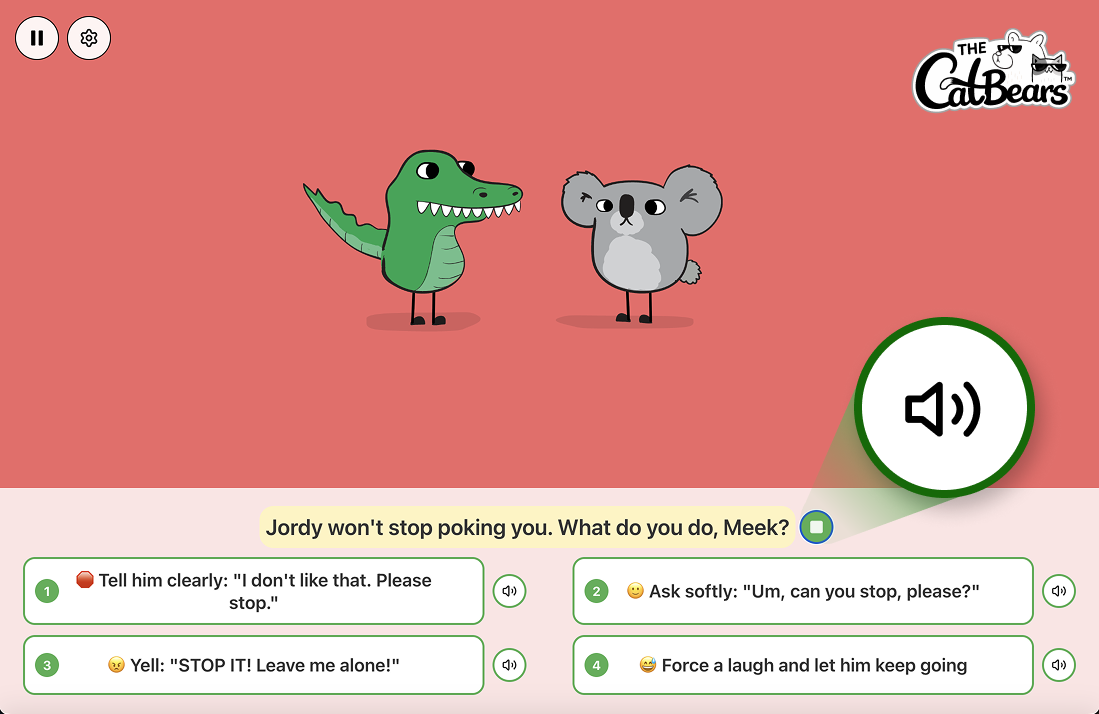
In Boop Boop your child plays as Meek. Jordy keeps poking him and thinks it is hilarious. Jordy is not a bully, and that is the whole point: he is a good friend with a blind spot, too deep in the game to catch a gentle hint.
Your child decides what Meek does. Ask softly. Say it clearly. Yell. Laugh along. Get a grown up. Walk off without a word. Push him away. Every choice plays out, and every ending shows what it left behind, for Meek and for the friendship both. Nothing is graded and nothing is preached at. The fake laugh just quietly leads to Jordy saying "see, you love it" and poking harder, and a child feels that in a way no lecture reaches.
The whole game is narrated. There is a small speaker button next to the question and next to every answer, so a child who does not read yet can hear the question, hear each choice, and pick for themselves without a grown-up reading the screen for them.
It takes about five minutes, it is free, and there is nothing to sign up for. The best part is what happens after, when you ask your child which one they would really do.
What we are actually giving them
A child who can say "I do not like that, please stop," warmly and then again if needed, has something much bigger than a way to stop being poked.
They have permission to exist fully inside a friendship. To be someone who stays and speaks, rather than someone who smiles and slowly leaves. And they have learned the thing many adults are still working on, which is that the people worth keeping are exactly the ones who want to know what you need.
That is not a small skill. It is most of what makes closeness survivable, and it starts with one kid on a playground, finding the nerve to say a true sentence kindly, twice.